Wednesday, 23 November 2011

Chickens

I have always wanted to have chooks not just for the eggs but to eat all the food scraps that go into the compost. The biggest problem in a rural setting is keeping the chickens safe from foxes and snakes. Yes, we have both! I was driving down our driveway this morning and saw a fox stalking a duck.
My good friend Sarah, a fellow Dorper sheep breeder lost nearly all of her chickens to a fox. It was very distressing for her and the surviving chickens.


Alison found this Red Belly Black snake sunning itself in the back paddock. Lucky she did not step on it because they are very poisonous

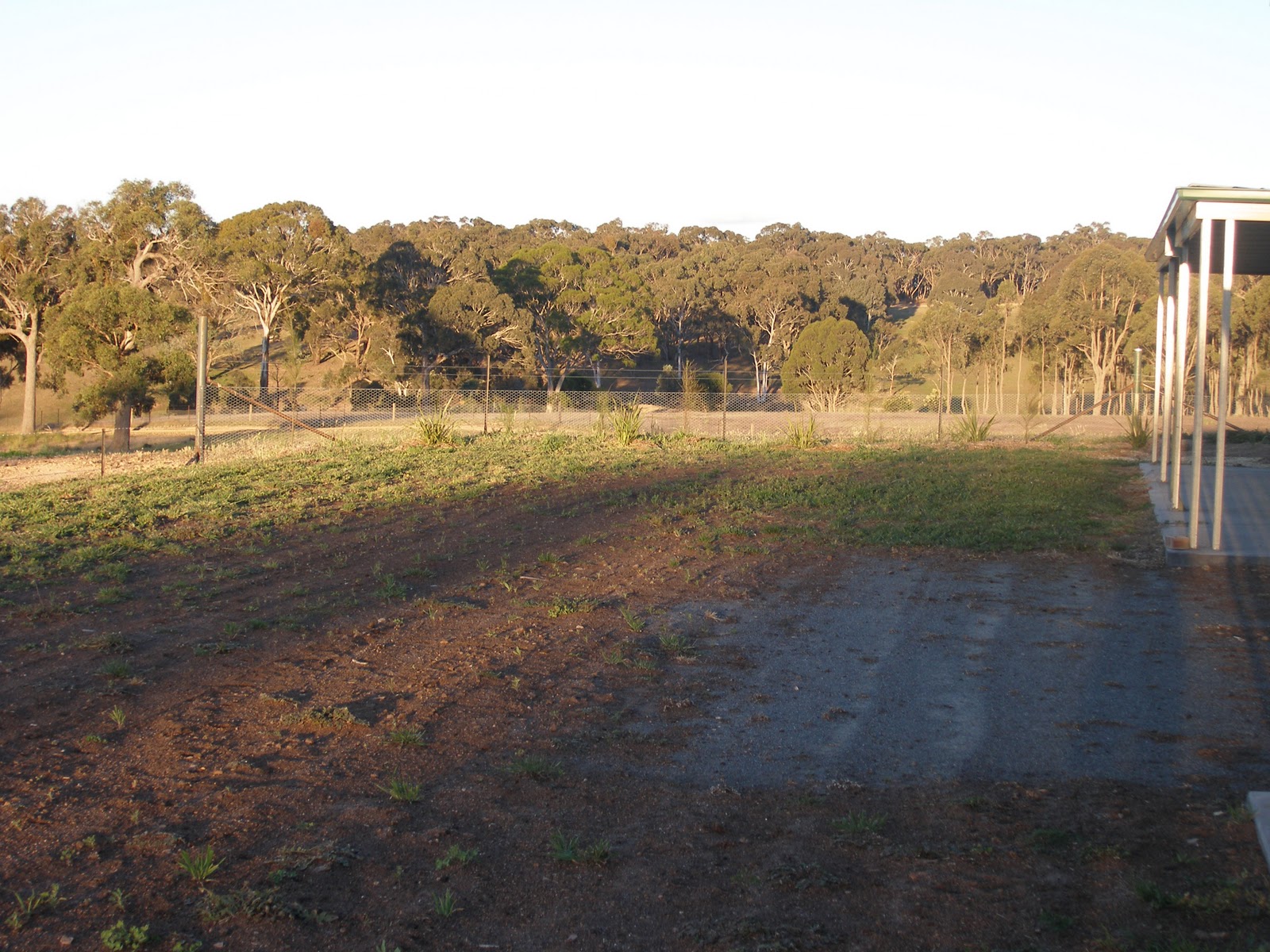
So with chicken safety in mind Kim the researcher in the family started looking for good, safe and sturdy chicken coup designs. He found a terrific design not on the internet but from another good friend who is also a client. The coup will be chicken heaven with 12 metres by 8 metres of space to free range. Where to build the structure also required some thought. Not too far from the house and close to a water source. We decided on the small paddock beside the house that is easily accessible and has water plumbed to it. Kim & Cam drew up the plans and worked out what materials would be needed. We started sourcing the materials which included a trip to Sydney to buy mesh that Kim found on eBay. Kim, with good friend Murray are busy today building the coup and chicken run. I'll post some pictures of the progress tomorrow.

As promised here are the progress pictures of Cluckingkam Palace. Not bad for one days work by two old blokes. 19 holes excavated with 19 posts concreted and frame erected.


I just can't wait to get started. Anyone got some good advise on keeping chickens

Here are some the breeds I like.

sussex chicken is a dual purpose breed that is a popular backyard chicken

Light Sussex

Barnvelder-chicken

Barnevelder


Isa Brown


Sebrights

Monday, 21 November 2011

Solar Power

We use a lot of electricity at Claremont. The average large household would use about 20 kilowatts per day. The farm uses between 45 and 50 kilowatts per day. I could never understand why because there is solar hot water, no electric heating and gas cooking, what could be using all that power. Until I realised every time a tap is turned on or a toilet is flushed several pumps are being used and these pumps are powered by electricity.
Kim started doing some research on alternate ways to generate electricity. Initially he thought wind power as Claremont is located in a windy area. We bought an anemometer had monitored the wind strength for six months and to our surprise the wind was not strong enough or consistent enough to meet our needs.
Next choice solar power! The government was offering some great incentives for people to put solar panels on house roofs and feed the power back to the grid. We would get 60.8 cents for every kilowatt generated which meant that 40 cents of every kilowatt could be used to pay for the system. This contract would last for seven years.
The cost of the system that would generate enough power either wind or solar was enormous at around $60,000.00 for wind and $50,000.00 for solar.
We decided to go for the solar system and had 60 solar panels installed on the shed roof in July of 2010. In the 12 months that the system has been installed the average kilowatts per day has been 48. The system will pay for itself in a few years and then the power bills should be nil or very small.


You can see some of the panels on the shed roof.

Sunday, 20 November 2011

Good Friends

Before we moved to Claremont we lived in the big smoke in a beautiful house that Kim built in a lovely suburb called Fadden. When  we first started building a good friend of Kim's introduced us to Jeff and Judy Brown neighbours who lived across the road. That was in early 1991 we are still best friends today. We would spent many weekends with the Browns helping each other with garden projects, paving, tiling and enjoying a glass of wine or a beer at the end of the day. Kim and I are really blessed that we had met great neighbours that then develpoed into a lasting friendship.
Fast forward 10 years and Kim and I are seriously looking for a property and in 2003 we found a beautiful spot that met all the requirements.
1. Not more than 30 minutes from town
2. Located on a sealed road
3. Must have good outlook and views
Kim and I both worked in Canberra at the time so commuting distance was important.

We planned stay in the Fadden house until the new house at Claremont was completed. Every weekend there would be a picnic at at beautiful spot on the property. We all loved the outings, trees were planted, dead branches piled up and much to Jeff's delight, burned.

Here we are on one of those happy weekends


Jeff, Kim youngest daughter Alison and grandneice Nicole.


Much activity during the shed construction


Shed contrction completed now onto the house.
Jeff organising a hopper for the rubbish

Judy pondering about the contsruction


Jessica, Alison, Kim and Jeff discussing construction


Kim and I something was amusing us


Jeff and I filling tthe water cart so we can water trees.


The shed with Jeff and Judy's caravan

Once the house was completed Jeff and Judy parked their caravan under the awning of their side of the shed. Later they a room was built with a kitchen and lounge room for their weekend visits


Judy and the sheep feeding them some bread


Jeff and Judy have helped us establish the farm with fences, planting trees, watering and building projects. Jeff has added another shed since then but that is a whole new post.

Tuesday, 15 November 2011

Controlled Breeding Plan

We love our sheep and are very proud of the sheep we have bred. We started breeding stud sheep in 2006 after deciding to down size the flock from 250 commercial breeding ewes to 150 stud ewes and concentrate on breeding top quality White Dorper rams. Our first drop embryo transfer (ET)Stud White Dorper lambs arrived in April of 2007

Here are the original first and second cross Dorper sheep in 2005

We have 3 top quality breeding rams and normally Kim will divide the flock into lots of fifty and put a ram in with each flock. However, this year after speaking with the South African inspector Kim decided to try controlled breeding. Using this method the ewes breeding cycle is is controlled and you know when the ewe is ready for the ram.
 Two weeks prior to joining CIDR's are inserted into the ewes and left in place for 14 days. The CIDR's are removed and a hormone injection is given then, 48 hours later, the ram is placed with the ewes.
We are repeating this method with five ewes at a time. This means we will know exactly when the lambs are due and can monitor the ewes closely. We are hoping for 130% lambing or better, we will know after 147 days how the first batch worked out. This method will mean a lot of extra work for Kim so we will be very intersted in the results.
EAZI-BREED™ CIDR® Sheep Insert 
The EAZI-BREED™ CIDR® Sheep Insert is a convenient and effective method for inducing estrus in production animals. EAZI-BREED™ CIDR® Sheep Insert contain the natural hormone progesterone. Intra-vaginally placed CIDR's release progesterone at a controlled rate into the blood stream

We put a harness on the ram with chalk so when he mounts the ewes a red mark will be left. We put the ram and his first five ewes together yesterday, and I think Leroy, the type 5 ram was very busy last night.
The sheep are in the process of shedding their fleece and look a bit ratty.


Saturday, 12 November 2011

Rural Garden


These pictures were taken in March 2005 when the first landscaping commenced.
The house in the desert not long before we moved in. 


I love gardening and in every place we have lived there has always been a nice garden. When we purchased this property it was a 200 acre paddock with one dam and a parameter fence. Lots and lots of infrastructure had to be installed before we could even commence the house or even think of a garden. Electricity, access roads, sewerage and the most important water.
We decided to build a shed first so we could store stuff and have some shelter from the elements while building the house. That first year the weather was hot, dry, and very windy to say I was apprehensive about rural life was an understatement.
The weather in our district can be harsh with very strong westerly winds and freezing winter nights. Although we rarely get any snow. The house sight was chosen to obtain the best solar aspect. This means the sun comes into the house during the winter and the veranda keeps the sun out in the hot summer months. We moved into the house in November 2004 the wind was blowing a gale of dust and it was hot. The house was not finished missing a veranda and a few other cosmetic jobs. There was just the house in a 200 acre paddock with 250 sheep in what looked like a desert at the time.

Things are better six years after we started work on our garden. I decided the plant hardy plants and trees that were drought tolerant. I only water once a week in the dry times and never water the grass. It dries off in Summer and usually greens up again in the Autum


Kim and Jeff with the water cart that Jeff built. We used it a lot to water plants that we have planted in the paddocks.


Wednesday, 9 November 2011

Pet Sheep


When you have a sheep farm you usually end up with poddy lambs. I personally would never leave a lamb that I thought may not survive the night in the paddock.
When it is lambing time Kim checks the ewes twice a day to ensure all is well with the flock.  If he sees a lamb that is weak or a twin/triplet lamb that is very tiny they usually end up at the house being hand reared.
Our first poddy lamb Baa Baa is now 6 years old although he is a wether and would normally end up on the dinner plate I just could not eat a pet. So he stayed with the flock and lives a happy life.


Sheep actually make good pets, they are very low maintenance and very friendly. Baa Baa is like a dog always looking for a snack of bread or a scratch behind the ears. If, you allowed him Baa Baa he would inside the house lying beside your chair. Sheep belong in a paddock you can’t keep sheep in your garden because they will eat every plant and flower in sight.


My friends daughter feeding Pixie. Pixie is now fully grown, had 2 lambs and still come up for a pat. check out the bottle it is an old beer bottle.


Me giving orders to my friends kids about feeding lambs. Being fed is Speedy. He was a mernio that my daughter found in the middle of the road on a freezing winter night. Sadly Speedy died this year


A friends daughter giving Daisy a pat. She was the best behaved poddy lamb. We had an old green bath mat that we called her grass. We would tell her to lie down on the mat and she would. Daisy is still with us and has a few lambs she also still comes up for a pat.


Here is Baa Baa coming to see what is going on.


Good friend Kerrie holding Pixie


Pixie in her bed after a long day with the kids

We feed our poddies full cream powdered cows milk made up with water to the instructions on the package. New lambs are started slowly 60 to 100 ml and frequently 4 or 6 times a day. We never, repeat never feed the lambs through the night. By the time they are about 2 weeks old they are on 4 feeds a day then gradually this is reduced to 2 feeds per day. We usually wean them at about three months. Although I know people who wean lambs much ealiuer than that.